

Yes. Medicaid pays for respite care through HCBS waivers in most states. Respite care gives primary caregivers, often family members, temporary relief from looking after individuals with disabilities or chronic illnesses. Most families don’t realize Medicaid can pay for respite care. Each state has different guidelines and waiver programs.
This article will cover what respite care costs out of pocket, what Medicaid covers, what Medicare covers, and how to access it in Givers' active states.
Respite care is temporary, short-term relief for a primary family caregiver. Someone else steps in for a few hours, a weekend, or a few weeks so the caregiver can rest, travel, or handle other responsibilities. Respite care is different from home care or long-term care because it’s short-term and temporary. The goal is a break, not permanent care.
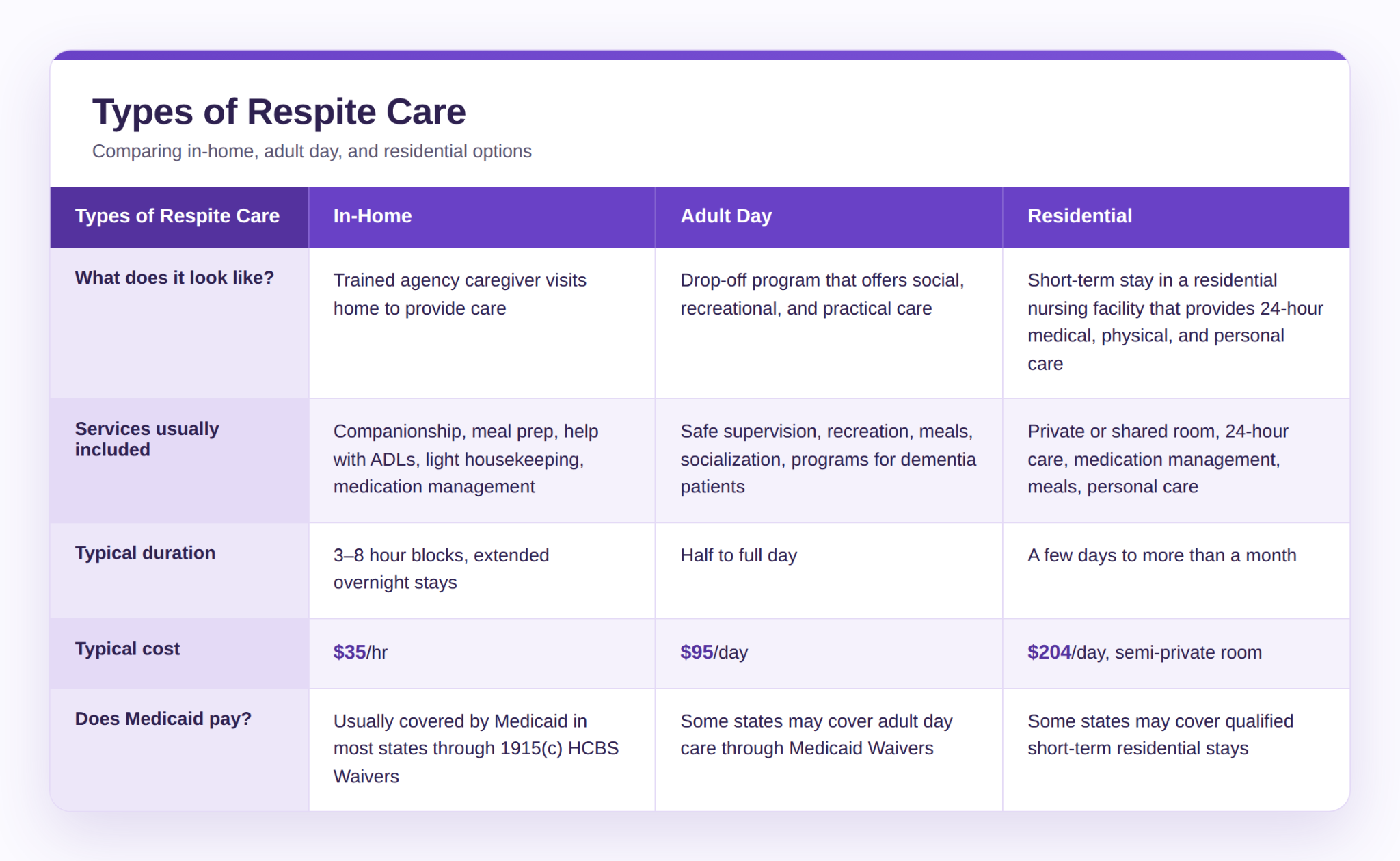
There are three types of respite care: in-home, adult day programs, and short-term residential stays. With Home-Based Services, a trained agency caregiver visits the home to watch your relative, giving you temporary relief. These services are usually available round-the-clock, every day of the year.
Adult day programs offer a safe community for aging adults and people with disabilities. Programs vary and can provide socialization, recreation, meals, and more. Family caregivers drop off the care recipient at the adult day program for a short break.
Your family member can stay at a nursing home or assisted living facility for short-term residential respite care. The stay can last days, weeks, or even months. The nursing facility takes care of all their physical, medical, and personal needs during the temporary stay.
Common scenario (illustrative): Maria Elena cares for her mother full-time in Atlanta. Her mother has mid-stage dementia and needs supervision around the clock. Maria Elena hasn't had a full night's sleep in four months. Givers helps her find a qualified caregiver to visit her home and care for her mom. Respite care means someone she trusts comes in for a weekend so she can visit her sister Isabella in Macon. Her mother stays home with her familiar routine intact, and Maria Elena comes back from Isabella’s refreshed enough to keep caring for her mom.
Respite care costs vary by the setting and duration of care. Many families pay out of pocket unless they have Medicaid, VA benefits, or long-term care insurance.
A 3-day weekend stay for a dementia patient in a short-term residential facility runs approximately $612 out of pocket at the national median daily rate. A weekend of in-home coverage at $35/hour, with one aide working two 8-hour shifts per day, would cost roughly $560. Both are significant costs for a family already stretched thin.
Yes. Medicaid pays for respite care in 47 states and the District of Columbia. These states offer respite services for aging adults and people with disabilities through the Medicaid HCBS waiver. Kansas, West Virginia and Illinois do not offer in-home or residential respite care for aging adults. Medicaid pays for adult day care in all three states, which is typically an 8-hour respite.
All 50 states provide some sort of respite care. Coverage differs in each state. In 37 states, waiver language includes a set limit above which no family caregiver can receive respite regardless of what the participant's care plan includes.
In 2025, over 600,000 people were on waiting lists for Medicaid HCBS across 41 states, with an average wait time of 32 months. Most Americans remain eligible for other types of home care while they wait. Apply early.
Coverage differs by state, both the services offered and the specific program requirements. Some Medicaid waivers cover adult day care services. Short-term residential services are usually limited to shared room nursing rates for a set amount of time.
Medicaid waivers cover the cost of respite care in three categories:
In 2025, there were 47.9 million caregivers in the United States, with many caring for family members with dementia-related conditions like Alzheimer’s disease. Dementia caregivers experience a high rate of burnout, and it’s the number one reason they look for respite care.
People with dementia often have difficulty with changes in their routine, caregivers, and environment. In-home respite care works best for these patients. They stay home in a familiar space and usually maintain their usual routine. This means less anxiety and better outcomes at home over a facility stay.
Fortunately, many metro areas have adult day care programs designed for memory care. They provide structured activities and supervision during daytime hours. Family caregivers can trust that their loved one is in a safe setting with professionals trained to oversee dementia patients.
Short-term residential respite in a memory care unit offers longer breaks, but needs some preparation. If you decide to place your family member in a short-term residential facility, take some time to introduce the facility and staff gradually. Try to maintain familiar routines and bring favorite familiar objects.
Medicaid waivers in most states cover in-home and day respite for dementia patients. Ask your waiver coordinator which types of respite your program covers.
Eligibility requirements for respite care differ by state. In general, to be Medicaid-eligible, income needs to be under $2,982/month with assets under $2,000 in most states for a single individual. They need to show they have a functional need and are unable to perform at least two ADLs.
Your family member must be enrolled in or eligible for their state HCBS waiver program. Apply as early as you can. Medicaid waivers have waiting lists and enrollment caps in most states.
“The most common misunderstanding is families think their income makes them ineligible before checking. Medicaid's income limits for HCBS waivers are often higher than people assume, and they rule themselves out without applying. The second most common one: families assume respite is a separate application from the waiver itself, when it's usually a service authorized within an existing care plan. And families already enrolled in SFC often don't realize respite is available to them at all, because they associate the waiver with their own caregiver pay, not with a break for themselves.” - Max Mayblum, Givers Founder and CEO
Yes, being the paid, enrolled caregiver doesn't disqualify your family from respite. The two benefits run side by side, funded through the same Medicaid waiver.
With Structured Family Caregiving or consumer-directed programs, a family member is already being paid for caregiving. Respite involves someone else stepping in so the primary caregiver has a much-needed break. This is the exact confusion Givers hears most often from families already receiving SFC pay: they know the waiver covers their pay, but don't realize it also covers their own time off.
Most Medicaid waivers provide a set number of respite hours each year. Depending on the state program, the waiver may cover a backup in-home caregiver, a professional, or a short-term facility stay. Some state programs offer more flexibility on who provides respite for an SFC member.
SFC is available in 11 states in 2026. North Dakota does not have Structured Family Caregiving but has Family Personal Care, which is similar. Givers currently operates in Georgia, Ohio, and Connecticut, with Michigan launching September 2026.
Common scenario (illustrative): David is enrolled through Givers as his father's paid caregiver in Ohio. His father's PASSPORT waiver respite hours are set case by case for each state care plan. When David's daughter gets married in June, he uses 48 available respite hours for two days of in-home respite coverage so his father has care while David travels. He doesn't lose his caregiver status. The respite is built into the waiver.
Medicare does not cover routine respite care, regardless of age or diagnosis. If the care recipient is enrolled in Medicare hospice care, then Medicare Part A covers up to five consecutive days of inpatient respite in a Medicare-certified facility for two 90-day benefit periods, followed by unlimited 60-day benefit periods. The family pays 5% of the Medicare-approved amount. This only applies to end-of-life care.
If you don’t qualify for Medicaid or need extra respite hours, there are a few options:
Medicaid has dozens of waiver programs most families never hear about.
See what’s available in your state.
The Medicaid process varies by state but has a general pattern. Most have enrollment caps or waiting lists. Apply as early as you can.
Note: Michigan is expected to launch in 2026. MI Choice Waiver will be active. Check givers.com/how-to-get-paid-caregiver/michigan for current status.
Applying for respite through Medicaid waiver programs involves several steps:
Approval is just the first step. Family caregivers still need to find an approved respite provider:
Structured Family Caregiving families enrolled through Givers work with our team to find approved respite providers in your state. Save time and avoid a logistical nightmare. Givers helps families in GA, OH, CT, and MI find approved providers and navigate the enrollment process.

The primary caregiver takes a break while a professional, volunteer, or facility steps in to cover their relative’s care. Your family member still receives care, and you get much-deserved rest.
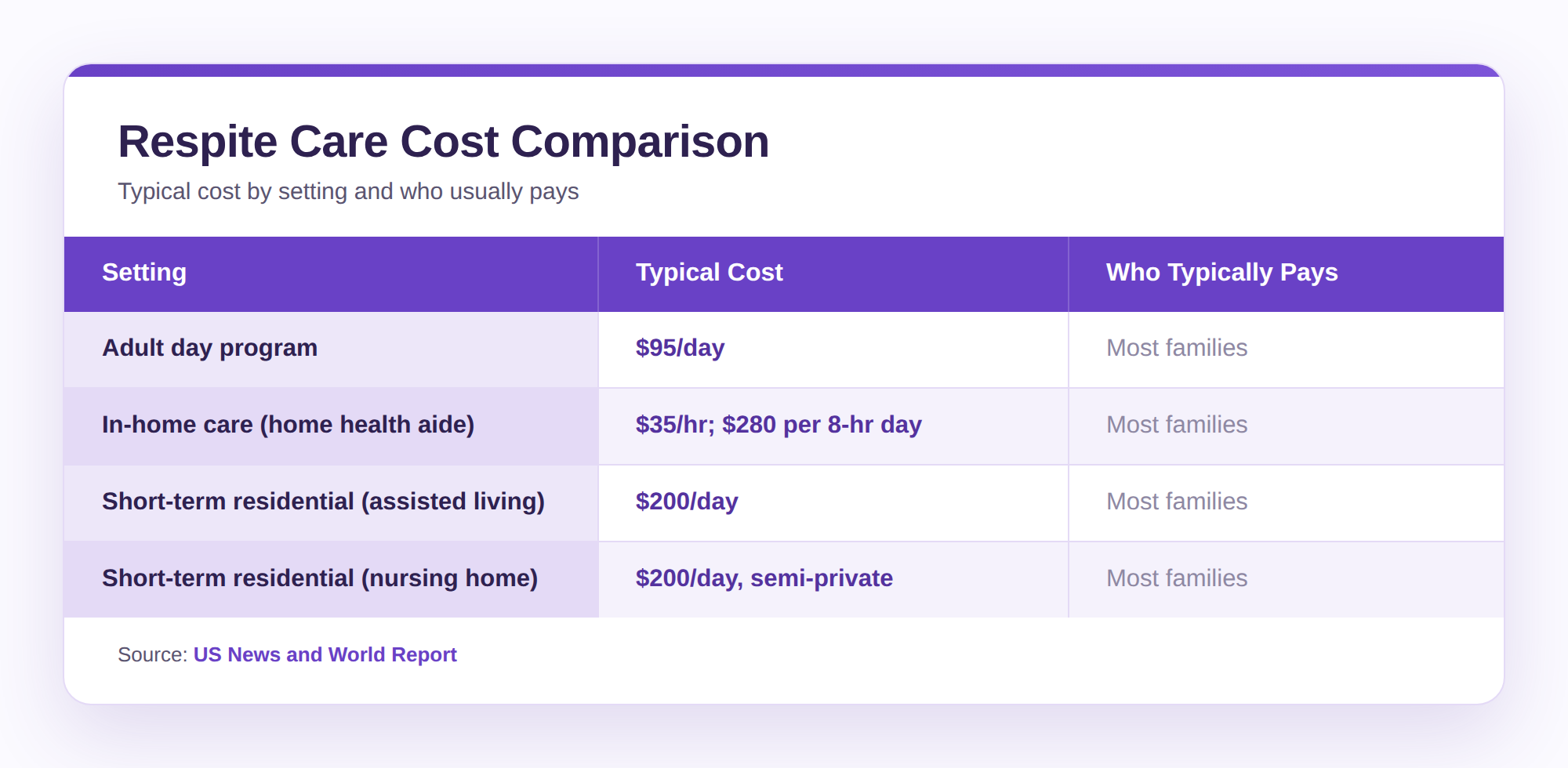
In-home respite from a home health aide averages $35/hour nationally. Adult day programs cost about $95 a day for an 8-hour period. Short-term residential stays cost around $200 depending on the facility and room privacy.
Source: US News and World Report
Medicare covers up to 5 consecutive days of inpatient respite only for care recipients enrolled in hospice. The family pays 5% of the Medicare-approved amount. Medicare does not cover routine respite care outside of hospice.
Eligibility depends on the state and the specific waiver program. Generally, the care recipient must be Medicaid-eligible and enrolled in an HCBS waiver that includes respite as a covered benefit. Income and asset limits apply.
Respite hours are set case by case depending on the care plan, setting, and funding. Medicare hospice care is limited to 5 consecutive days for two 90-day periods, then for unlimited 60-day periods after.
Probably not. Medicaid rarely offers same-day emergency respite, and most HCBS waivers require advance scheduling and provider coordination. In some cases like caregiver hospitalization or family crisis, the local Area Agency on Aging or state Medicaid coordinator may have options. The ARCH National Respite Network recommends finding emergency respite options and approved providers before an emergency strikes.
Most family caregivers show signs of burnout before they request respite care: exhaustion, irritability, social withdrawal, or declining health. Use respite care before burnout, not after. Don’t wait for a break.
“Caregivers rarely ask for respite directly. It usually comes out sideways — ‘I just need one weekend’ or ‘I haven't left the house in months’ — framed as a confession more than a request. Many preface it with guilt: ‘I feel bad even asking.’ The ask is almost always minimized relative to how much support they actually need, which is part of why respite gets requested later than it should — after burnout, not before it.” - Max Mayblum, Givers Founder and CEO


